
Pop-Up and Folding Soccer Goals Compared for Wholesale Buyers
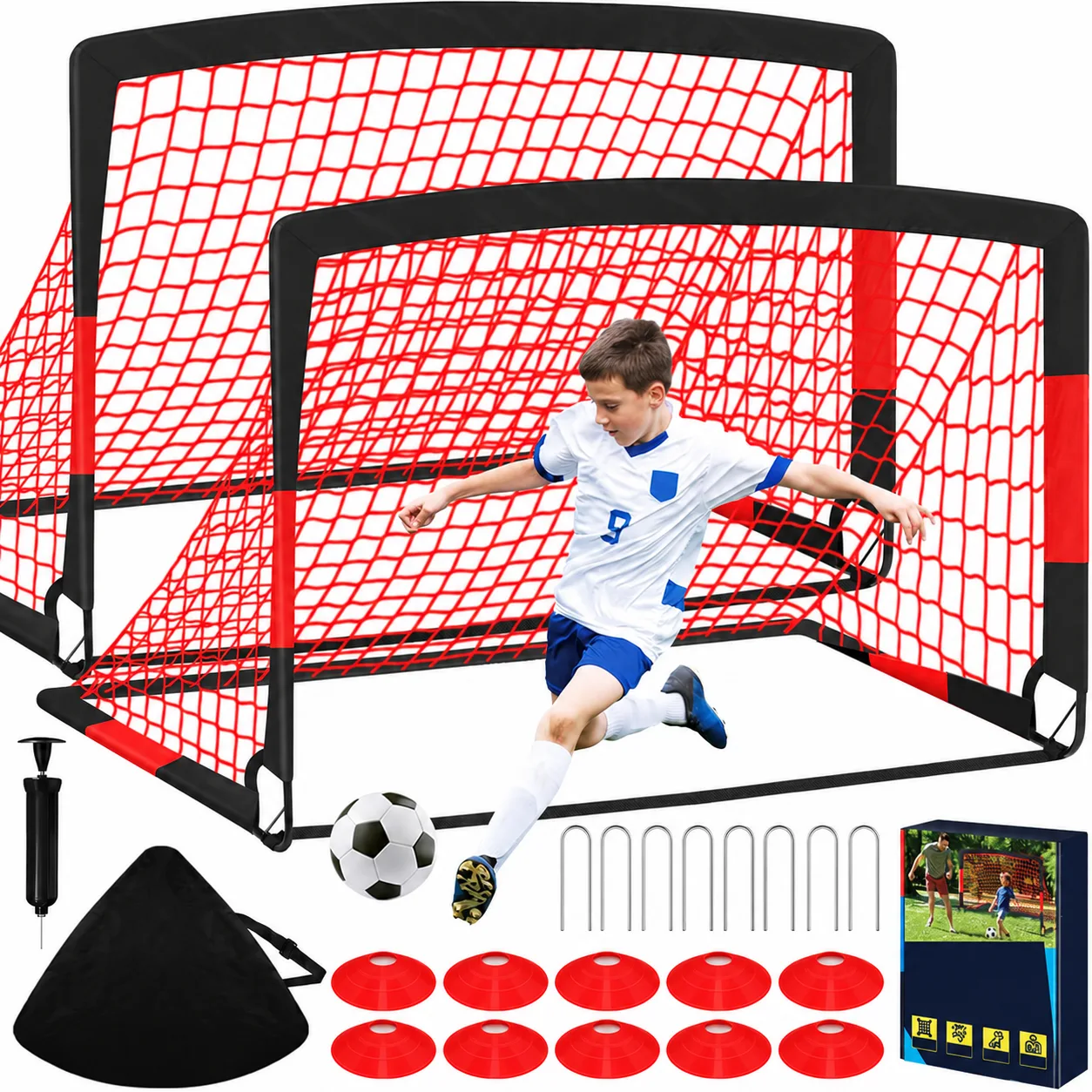 KS-SG-6 · Two-goal set
 KS-SG-7 · Folding-base goal
For a sports brand or distributor choosing portable soccer goals, the useful comparison starts with the frame and the way customers will store it. A goal that folds into a flat pack and one with a folding base can both be described as “pop-up” or “portable.” Those names alone do not tell you which will fit your product range.
Compare how each model opens, how it packs away, what comes in the set and what its instructions require. Then compare quotations for equivalent configurations. There is no single construction that is the best choice for every customer or training space.
Look beyond the product name
Three construction patterns are worth distinguishing when reviewing portable soccer goals. These are descriptions of how the equipment works, not formal quality grades. A particular goal may combine features from more than one pattern.
Spring-frame goals use a flexible frame that opens from a restrained position and twists or folds for storage. Opening the goal and packing it away are different tasks. For example, the FORZA FLASH instructions show a folding sequence and recommend becoming familiar with it. That illustrates why a buyer should review the complete handling process, rather than judging convenience only by how the goal opens.
Sectional-pole goals use connected support pieces to form the playing shape. Review the joints, the way the net or fabric sleeves attach, and which parts remain connected during storage. An assembly demonstration should show the actual configuration being quoted.
Goals with a folding base combine a base that folds or retracts with supporting components. Examine both operations: collapsing the base and storing the supports and net. A folding mechanism does not, by itself, establish a compact shipping carton or a particular service life.
Compare the handling tasks that matter to customers
On small screens, swipe across the comparison table to view all columns.
| Construction to review | What to observe in a sample | What to clarify before ordering |
|---|---|---|
| Spring frame | How the frame opens, folds and is secured for storage | Folding instructions, packed shape and storage arrangement |
| Sectional poles | How parts connect, how the net attaches and which pieces stay together | Parts list, connection details and replacement-component options |
| Folding base with supports | How the base opens and locks, and how supports are removed or stored | Folded dimensions, loose components and complete kit contents |
If your customers carry equipment between locations, review the packed kit as well as the assembled goal. Check whether the bag holds all the quoted accessories and how the kit is carried. If the goal will be stored in a garage or equipment cupboard, the longest packed component may matter more than a general description such as “easy to store.”
If setup speed is an important selling point, agree how it will be measured. Identify the starting condition, included tasks and person doing the assembly. Do not transfer a competitor's advertised setup time to another model, or present an experienced demonstrator's time as a guarantee for every customer.
Compare equivalent sizes and complete sets
A small target goal and a larger practice goal can serve different purposes. Their prices or packed sizes are not a useful like-for-like comparison unless you account for those differences.
Record the goal opening as width by height, then list assembled depth separately. Ask for packed length, width and height for the selected configuration. Keep product weight, packaged weight and carton measurements distinct. A two-dimensional carry-bag illustration cannot establish shipping volume.
Next, specify what the sale includes. One goal, a pair of goals and a training kit containing balls or cones are different offers. Comparing only the price per “set” can hide those differences. Give the quoted set a clear contents list that can also be used for packaging and customer instructions.
Match the product to the intended setting
Discuss where the goal will be used, who will assemble it and whether it will be put away after each session. Check the fixing method and suitable surfaces in the selected model's instructions. Included ground stakes do not establish suitability for every surface.
Storage expectations also need to be explicit. For example, the QUICKPLAY KICKSTER 16 × 7 ft instructions call for the product to be packed away after use. That requirement belongs to that model; it is not a rule for every portable goal. It shows why “outdoor use” should not be interpreted automatically as permission to leave equipment outside permanently.
For club or competition customers, confirm the requirements for their intended use separately. A familiar goal size is not proof that the complete product meets a particular competition specification. Likewise, material names alone are not evidence of impact performance or weather resistance.
Two configurations from the KAYRIDA range
Our KS-SG-6 portable soccer training set is an example of a two-goal offer. Reference sizes are 4 × 3 ft and 6 × 4 ft. Its construction combines polyester netting, 450D Oxford fabric sleeves, fiberglass poles and steel corner components.
The reference set includes two goals, a size 3 ball, a pump, ten training cones, eight ground stakes and a carry bag. A shooting target sheet is an optional addition. For a retailer planning a coordinated training set, this provides a configuration to review; final accessories and quantities can be discussed.
Our KS-SG-7 collapsible soccer goal illustrates a folding-base format with a 12 × 6 ft opening and 3 ft assembled depth. The reference construction uses an alloy-steel base, fiberglass supports, HDPE knotted netting and Oxford fabric. Its quoted set should identify the goal, fixing components and carry bag.
These examples serve different product briefs. They are not evidence that a folding base is always better than a spring frame, or that a larger goal is the right choice for every range. Start with the size, handling and set contents your customers need, then review the relevant sample.
Turn the comparison into a wholesale brief
Before confirming an order, record the selected model, dimensions, construction, accessories and approved sample details. Ask about replacement parts that matter to your after-sales plans rather than assuming every component is available separately.
Branding, colours and instructions can be discussed through our OEM customization options. Review final packing using the portable equipment packaging checklist. Carton dimensions, units per carton, gross weight, MOQ and timing depend on the selected product and order requirements.
KAYRIDA is a sports equipment manufacturer in Huizhou, Guangdong, China, focused on portable sports nets and hitting mats. Complementary accessories may be supplied through partner factories; we can clarify the production scope for your proposed set.
Tell our factory the soccer goal or set you are considering and your approximate quantity. If the structure is not decided, describe how your customers will use, move and store it. We can discuss a suitable configuration without requiring a complete specification in your first message.