
Why Do Some Putting Mats Have Two Holes?
Two holes of different sizes let a golfer switch between a wider target and a narrower one on the same putting mat. The smaller opening leaves less room for an off-centre ball; the larger opening offers a less demanding target. That is a useful way to vary a short practice session, but hole count alone says little about the quality of the complete set.

For a brand or retailer choosing a two-hole putting mat, the important questions are whether both targets work with the printed lines, how the raised end affects the task, and whether the assembled mat fits the customer's space. A second hole should provide a usable alternative, not just another feature on the box.
A larger practice hole is not necessarily regulation size
Do not assume that the larger of two openings matches a golf-course cup. The R&A and USGA's 2023 Rules of Golf, still listed in The R&A's current rules resources when checked in November 2026, define a course hole as 4¼ inches (108 mm) in diameter. That is a reference for the hole on a putting green, not a requirement for an indoor practice aid. Source: Rules of Golf, definition of “Hole,” page 220.
For example, Perfect Practice's current V5 Standard specification, checked in November 2026, lists openings of 6.5 cm and 8.5 cm. Both are smaller than 10.8 cm. Its Compact edition lists a single 6.5 cm opening, showing that target layout can also change between sizes in one product family. Source: Perfect Practice's model comparison.
When reviewing a supplier's sample, measure both clear openings and write each diameter into the specification. “Small and large” is suitable descriptive language; “regulation-size” needs a matching measurement. Keep the dimensions tied to the actual model and revision rather than copying them from a similar-looking mat.
The lines and the ramp change what the player is practising
Printed lines give the player a visible reference for where to start and where to aim. On a two-hole mat, check that each line leads to its intended target. A distance label also needs a defined reference point: a mark measured to the front edge of a hole is not the same as one measured to its centre.
Markings can support a different practice format without a raised cup. PuttOUT's current Medium Putting Mat, checked in November 2026, lists alignment lines, pace targets and distance markings up to 6 ft, on a mat whose overall length is 240 cm. This is a useful distinction for buyers: the longest printed practice distance and the total product length are different specifications. Source: PuttOUT Medium Mat.
A raised-hole mat asks the ball to climb at the end of its roll. A flat target area lets the player observe where the ball stops without that final climb. Choose the format around the intended task. A compact two-hole return mat suits repeated putts towards fixed targets; a flat layout with pace zones may better suit customers who want to compare finishing distances. Neither layout, on its own, reproduces the changing slopes of a course green.
The smaller opening makes the target narrower. It does not, by itself, establish how much a player's putting will improve. Keep retail copy focused on what the equipment lets someone do: select a target, use a marked starting position and repeat the task.
Review the two targets as part of one complete set
KAYRIDA manufactures the KS-PM-2 wood-base ball-return putting mat in-house in Huizhou, Guangdong, China. Its reference design combines two different target openings, a raised wooden base, distance and alignment markings, and a gravity return track. Confirm the exact mat dimensions, opening diameters and printed scale against the sample selected for your order.
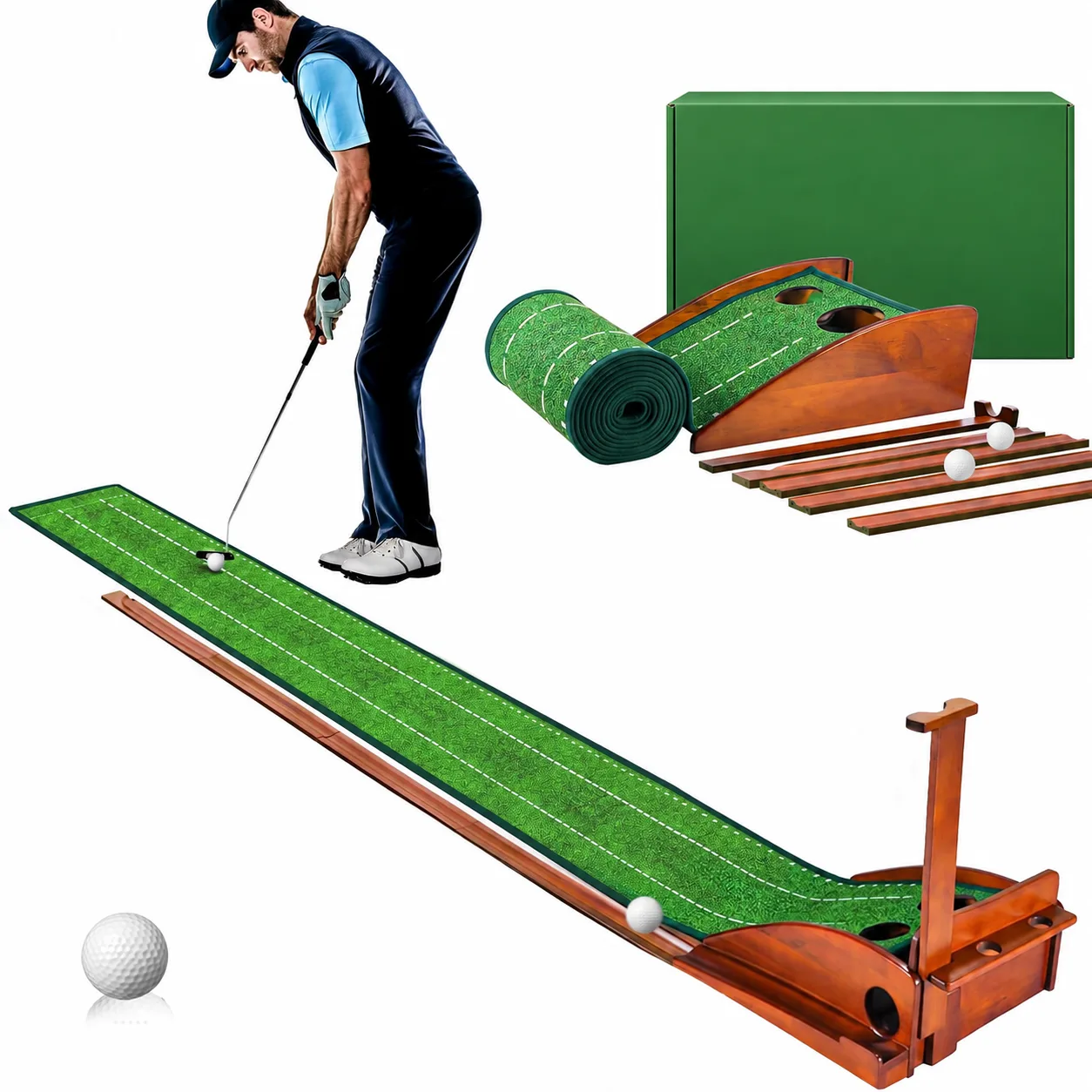
For sample approval, ask for a top view showing both holes and their lines, a side view of the transition onto the base, and a short demonstration through each opening. Watch the ball enter the return channel and travel across the assembled rail joints. Check misses separately: a successful putt returning does not establish what happens to a ball that passes beside either hole.
Measure the whole assembled footprint, including the base and return rail, then allow room for the player's stance and putter. A narrow strip can fit along a wall while still leaving too little space to stand comfortably. For a home or office range, this fit check is more useful than advertising the mat's length alone.
Turn the approved sample into a clear retail specification
Before ordering, record the two opening diameters, overall footprint, marked distances and their reference point, return-track components, and included ball quantity. State separately whether a putter is included. Use the same information in the quotation, component checklist and product listing so the buyer receives the set that was reviewed.
If you are adding this format to a putting-mat range, send us the product and approximate quantity, together with your destination market and intended practice space. We can discuss the sample configuration and logo requirements; packing, order quantity and lead time are agreed for that configuration.