How to Choose a Portable Soccer Goal Manufacturer for Wholesale Orders
When you are sourcing portable soccer goals for resale, a useful supplier shortlist starts with three questions: does the company make the kind of complete goal you need, can it show how that model is produced and checked, and will its quotation describe exactly what your customers will receive?
A low unit price is difficult to judge until those answers are clear. One offer may cover a single goal; another may include two goals, a carry bag and training accessories. Both can be described as a “portable soccer goal set.” For a brand, importer or distributor, the first job is to make the product and the supplier's responsibilities specific enough to compare.
Start with a complete-goal brief
Search for the type of goal you want to stock, then add the manufacturing or wholesale requirement. “Portable soccer goal manufacturer” is a useful starting point. Adding a required size or “private label” can help you describe the project more precisely, but the resulting supplier still needs to be checked against your brief.
Look at the actual products before requesting a catalogue. Does the supplier show a complete frame-and-net assembly, or mainly replacement netting? Are its examples small portable training goals, larger folding goals or permanent installations? A broad sports-equipment catalogue does not answer those questions on its own.
Your first message can be short: a product reference or photograph, the approximate quantity and a sentence about the customers you sell to. For a youth-focused range, note the intended age group, whether the goal is for home or organized practice, and the expected playing surface. Add the destination and any essential customization if known. You can work through the remaining specification together.
Participation context. UEFA reported in 2025 that its Football in Schools programme had involved more than 41,500 schools across Europe since 2020 and held coaching sessions for more than seven million children. FIFA reported that Football for Schools had been implemented in 129 member associations across all six confederations as of January 2025.
In the U.S., SFIA recorded 16.8 million outdoor soccer participants in 2025, up 15.8% from 2024.
These figures describe programme reach or participation, not portable-goal sales. Use your buyer brief to choose the goal format.
For the shortlist, record the opening size, structure, packed format and contents of one saleable unit. If you are still deciding between structures, our portable soccer goal comparison covers that choice separately. This guide assumes you are ready to assess who can supply the selected product.
Verify the manufacturing scope for that model
Ask which operations the company carries out itself, which components it buys in and who assembles and checks the final set. Keep the discussion tied to the goal you are considering. General factory photographs are useful background, but they do not establish that every product in a catalogue comes from the same production line.
More useful evidence includes current photographs or a walkthrough showing the relevant work, the selected model being assembled, and the checks used before packing. Ask the supplier to explain what you are seeing. Match the company details on its quotation with the business and facility information it provides; clarify any different entity involved before proceeding with the order.
A manufacturer may still buy accessories from specialist partners. A ball or pump in a training set need not come from the factory that makes the goal. What matters to the buyer is knowing who is responsible for the agreed contents, inspections and any correction if something differs from the order.
Factory-direct purchasing can make product discussions more direct, but it does not automatically guarantee the lowest total cost or the best service. Judge the supplier by relevant evidence and its ability to explain the proposed order. KAYRIDA's factory information is a starting point for that discussion; product-specific requirements should be reviewed alongside it.
Compare quotations against the same product
Send shortlisted suppliers the same essential requirements. Where they propose a different construction or accessory mix, ask them to identify the difference rather than burying it inside a price.
| Quotation item | Detail to make explicit |
|---|---|
| Complete product | Model, opening width and height, assembled depth and agreed construction |
| Saleable unit | One goal or a pair; bag and accessories with quantities |
| Branding | Logo location, colour requirements, labels and packaging included in the offer |
| Commercial scope | Order quantity, currency, sample charges, delivery basis and charges included or excluded |
For a two-goal training set, check whether an optional target sheet is included and whether the price assumes one or two sheets. For different sizes, ask for separate specifications rather than assuming the smaller version's depth, components or packing also apply to the larger one.
Carton measurements, units per carton and gross weight become meaningful once the configuration and packing are defined. They can be discussed during quotation; you do not need to arrive with those figures already worked out. If freight is an estimate, record the configuration it assumes and what still needs confirmation. Our packing checklist covers the details without turning the first enquiry into a lengthy form.
Use a sample to resolve open questions
Before arranging a sample, agree what it will demonstrate. An existing unbranded model may help you review the structure and handling, while a later sample or other agreed reference may be needed for a custom logo, colour or packaging. Record differences between the sample supplied and the proposed production version.
Review the complete set against the quotation. Check the parts and accessories, assemble it using the supplied instructions, examine the connections and net attachment, and pack it away again. Note anything unclear, missing or different from the brief. Photographs tied to specific comments are more useful than a general message that the sample “looks good.”
Ask how the selected goal is secured on its intended surface and stored after use. The U.S. CPSC's voluntary guidance discusses anchoring and hardware checks for full-size or nearly full-size movable goals; it is not certification for a small portable training goal. Request setup and storage instructions for the exact model.
An assembly review cannot establish a claimed service life, impact performance or compliance with a particular requirement. If such a claim matters to your market or customer, ask for evidence relevant to the exact product and agree any further evaluation needed. Do not treat a document for another model as proof for the one you intend to order.
Close each sample comment with a clear decision: accepted, change required, or still to be confirmed. Keep the approved product specification and any agreed sample reference together so that later changes can be reviewed against the same record.
Make customization and order timing specific
A supplier's willingness to discuss a custom product is only the beginning. Ask which changes are feasible on the selected model and how they affect the quotation, sample work, quantity conditions and production schedule.
For example, KAYRIDA's KS-SG-6 portable soccer goal training set has 4 × 3 ft and 6 × 4 ft configurations. Size, colour, logo placement and the accessory mix can be discussed, with a shooting target sheet as an optional item. Those options belong to that product discussion; they should not be assumed for every goal in the range.
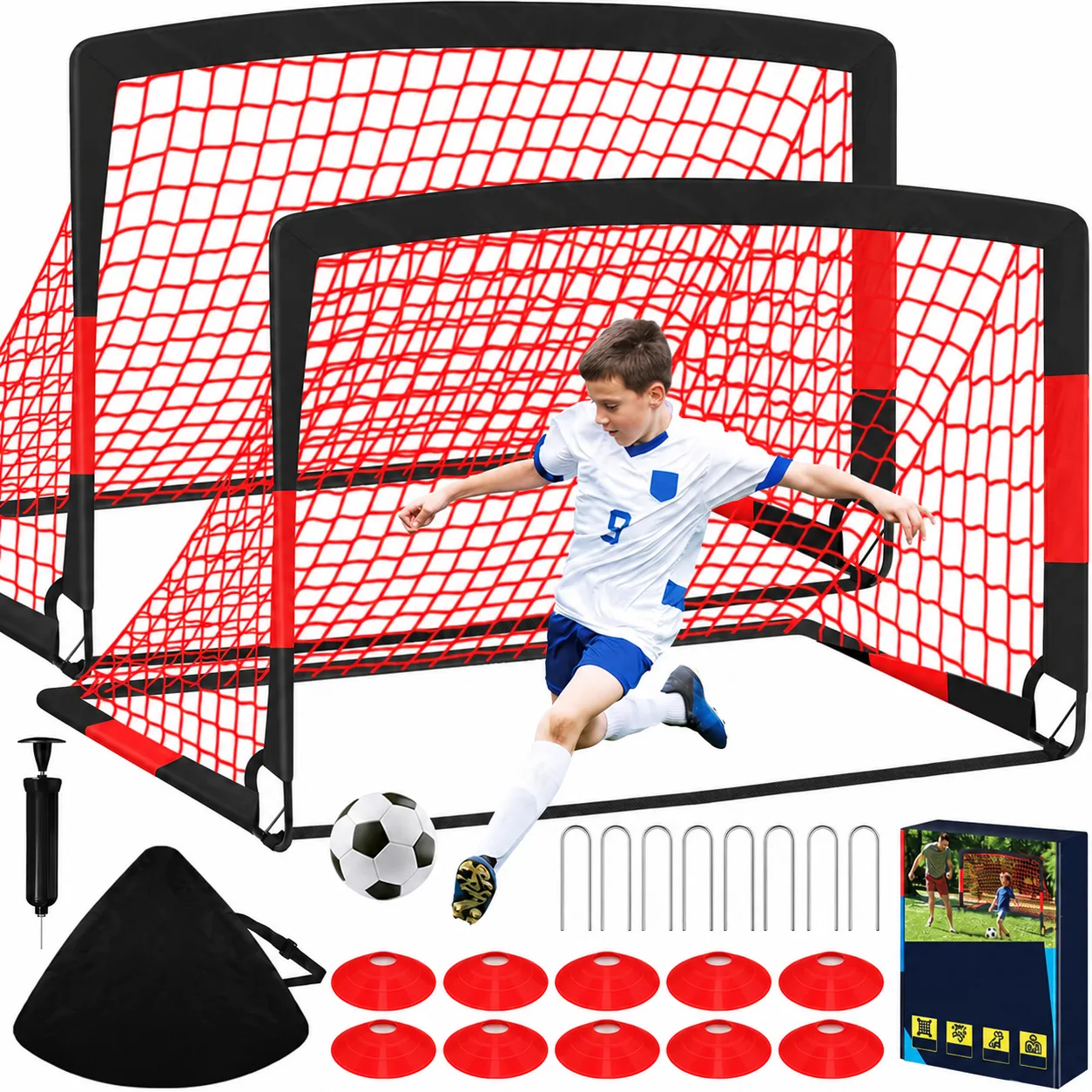
The KS-SG-7 collapsible soccer goal is a separate 12 × 6 ft product. Compare the model that fits your intended range rather than treating a larger goal as an automatic upgrade. You can review both within our soccer training range.
For either a standard or customized order, confirm the applicable MOQ and timing after the requirements are understood. State whether your target date means ready for dispatch or received at the destination. Ask which decisions must be finalized before the supplier can confirm the schedule.
Choose an offer you can verify
Before placing an order, keep the agreed specification, quotation and sample decisions together. You should be able to see what one saleable unit includes, who is responsible for the complete set and which details are still open.
KAYRIDA manufactures sports equipment in Huizhou, Guangdong, China and discusses complete portable soccer goal orders with brands, importers and distributors. To start that discussion, identify the goal or training set you are considering and give an approximate quantity; we can work through the remaining specification with you.