
Beach Putting Sets or Chipping Games? Choosing a Retail Range
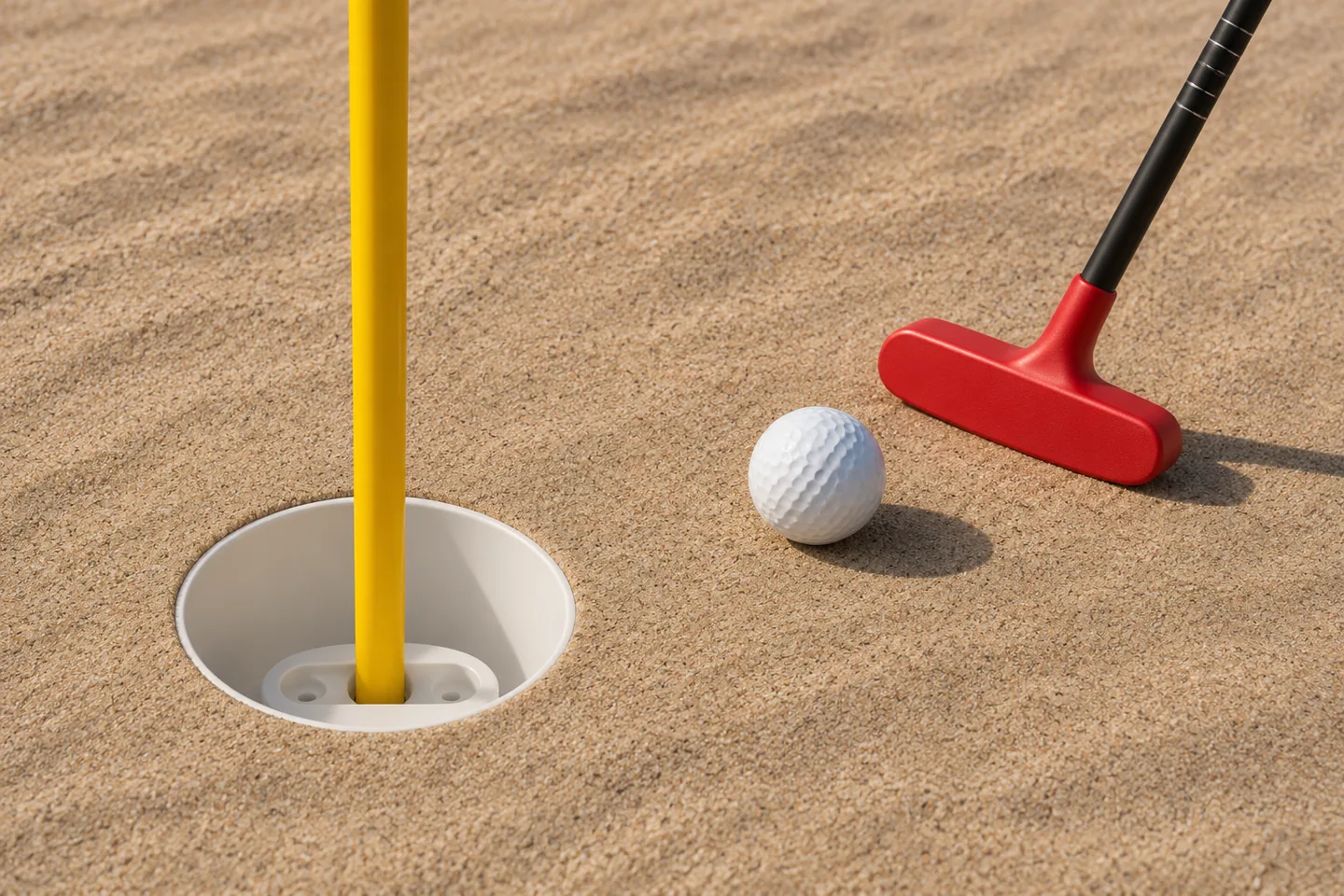
Choose a beach putting set when the customer wants to roll a ball into a cup on suitable sand. Choose a chipping game when the intended activity is to lift the ball toward a board or an above-ground target. For a retailer or importer, that difference comes before the number of pieces in the bag: it changes the club, the playing area and what the product listing needs to explain.
“Beach golf” and “yard golf” are broad labels. A photograph of flags beside the sea does not tell a buyer whether the game involves putting, chipping or both. Start the range decision with the shot and target, then compare the complete configuration.
Three formats that need different buying briefs
| Format | What the player does | What the buyer needs to establish |
|---|---|---|
| Sand putting with recessed cups | Rolls the ball along the surface into a cup | Suitable sand, permission to install cups, included putters and target count |
| Chipping toward a target board | Lifts the supplied ball toward scoring areas | Compatible club and ball, target setup, hitting surface and clear swing space |
| A course of above-ground targets | Moves between starting points and targets under the game's rules | Layout requirements, target fixing, ball specification and whether clubs are included |
Roll along suitable sand into a recessed cup.
Loft the specified ball toward a target board.
Move between starting points and above-ground targets.
These are buying distinctions, not rigid categories. Some sets combine activities. Beach Birdie's current US product page, reviewed in November 2026, lists both a wedge and a putter, along with a putting green and a chipping mat. A combined set needs a brief covering both activities; its name alone cannot establish its contents. Source: Beach Birdie complete set.
For sand putting, the ground is part of the game
In a cup-based putting game, the ball travels across the chosen patch of sand. That makes the surface part of the experience rather than simply a place to stand the equipment.
Sun Ninja's current US beach-set listing, reviewed in November 2026, specifies compact sand at low tide and lists two adjustable putters, three cups with flags and six balls. The useful detail for a buyer is the stated surface condition: “for the beach” does not mean every patch of loose or uneven sand will give the same roll. Source: Sun Ninja Beach Golf Set.
KAYRIDA's KS-GG-3 beach putting set, also referred to as GS-3, has a different confirmed configuration: two three-section telescopic putters, two white cups, two red-and-white flags with yellow poles, six white practice balls, a tee, a folding shovel, a carry bag and an instruction sheet. It provides two targets and a separate putter for each of two players taking turns.

The two-cup and three-cup configurations should not be treated as the same retail item. Decide how many target positions you want to supply and whether the customer should receive their own club or share one. More targets are an option, not evidence of a better game for every buyer.
For KS-GG-3, a sensible retail description is a portable game for short putts on a suitable, permitted sand area. A patio display would imply a different setup: the supplied recessed cups do not become freestanding putting targets simply because the equipment is portable. For play and pack-away guidance, see Beach Golf for Two.
Chipping changes the target, the ball and the space
A chipping board gives the airborne ball a defined scoring destination. Chippo's current US specification, reviewed in November 2026, lists two target boards, two chipping mats and six high-density foam balls. Its instructions recommend a wedge. Those are a different combination from putters and recessed cups, even though both products can appear in an outdoor golf-game range. Source: Chippo set contents, club guidance.
Buy the target, ball and club specification together. Do not replace a supplied practice ball with a regulation ball merely because both fit in the bag. The supplier's instructions need to cover the actual combination being offered. A small target also does not define the whole playing footprint; allow for the stroke, ball path and retrieval area.
Course-style games introduce another layout decision. BucketGolf's UK six-hole product page, reviewed in November 2026, suggests spacing its holes 10–40 yards apart for its custom balls. The same page offers club and no-club selections. That example shows why a target count and a generic bundle name are insufficient when comparing quotations: the intended layout and selected club option matter too. Source: BucketGolf six-hole configuration.
Turn the choice into a clear retail offer
For a beach-accessories range, consider whether customers will have suitable sand and permission to install cups. If so, a putting set can fit the intended outing. For a garden-game range aimed at chipping, specify the target system and its compatible equipment. Where the location cannot accommodate the manufacturer's setup, choose another format instead of describing the kit as usable everywhere.
Make the first product photograph show the activity; use a separate component image to establish what is supplied. If clubs are optional, the selected SKU, contents list and pictures should agree. Count cups, flags and clubs separately—two target positions do not necessarily mean two clubs.
A useful opening brief for KS-GG-3 is: “We are considering a two-player sand-putting set with two cups and two putters for [destination/channel], approximately [quantity] sets.” Add branding preferences if you have them. This is enough to start a configuration discussion without guessing carton dimensions or committing to packaging artwork before it is agreed.
At KAYRIDA in Huizhou, Guangdong, China, we help brands, importers and distributors specify complete outdoor sports sets. Explore our golf yard-game range or send the product and approximate quantity to discuss KS-GG-3, configuration, branding and order-specific packing.